
Before Underpinning Begins: Construction Survey Control for Baltimore Rowhouses
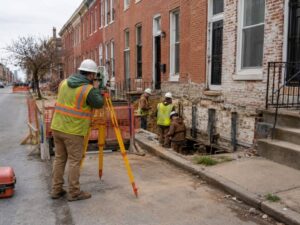
Digging next to an old wall is nerve-wracking work. When crews prepare to underpin a rowhouse, the ground shifts, equipment rumbles, and nearby walls feel every move. Construction survey control gives that work a steady set of reference points to trust. Before any excavation starts near shared structures, dependable measurements have to be in place. Those points let a team track the site precisely and catch trouble early, which matters a lot when neighbors share a wall. On a row of attached homes, one careless dig can affect the house next door, so the reference points aren’t a formality, they’re the safety net the whole job leans on.
Construction Survey Control Before Adjacent Excavation
Excavation near existing rowhouse walls demands a reliable frame of reference first. Underpinning works right beside shared structures, so a crew needs points they can measure from with confidence. Guesswork has no place that close to a neighbor’s foundation.
Setting control before the digging starts locks in that reference. Once solid points exist, every layout and check ties back to them. That consistency keeps the work honest as excavation, footings, and foundation steps unfold one after another near delicate walls.
Rowhouses raise the stakes on this. The walls are old, often shared, and unforgiving if the ground next to them moves. A reliable set of reference points gives the crew a fixed truth to measure against, so a small shift gets caught as a real number rather than a hunch. That early control becomes the backbone of a safe job.
How Is Survey Control Established Away From Active Excavation?
Control points work best when they sit clear of the action. If a point stands inside the excavation zone, digging, vibration, equipment, or stored material can shift or destroy it. A shifted control point quietly ruins the measurements that depend on it.
For that reason, a crew sets control outside the areas the work will disturb. The points get placed on stable ground and protected so they survive the whole project. Locating them away from the excavation keeps the reference steady even as the site around them changes daily.
Choosing those spots takes judgment. A good control point sits far enough from the dig to stay still, yet close enough to stay useful for daily measurements. Crews often mark them on solid features and guard them from traffic and stored material. When the points hold steady from start to finish, every reading taken from them can be trusted.
Baseline Measurements Along the Façade, Sidewalk, and Curb
Before work begins, a crew documents the visible features that frame the site to build a solid baseline:
- The facade line and key points along the building’s front face
- Sidewalk edges and levels next to the work area
- Curb positions and heights along the street
- Existing cracks or marks worth recording before disturbance
- Reference marks tied back to the protected control points
These baseline measurements capture the starting condition of the site. Recorded early, they give the team something to compare against as excavation proceeds. If something moves later, the original record shows how much and where, which turns a vague worry into a measured fact.
The record also protects everyone involved. If a neighbor claims the work damaged their wall, a careful baseline shows what the wall looked like before anything started. That evidence settles disputes with facts instead of arguments. So documenting the site up front serves both the safety of the job and the peace of mind of the people around it.
Can Construction Survey Monitoring Help Identify Movement?
Repeated measurements can help a team watch for movement during risky work. By checking the same points over time, a crew can see whether a wall, sidewalk, or curb has shifted. That data feeds a project monitoring plan.
The survey supplies the numbers, though it doesn’t set the limits. The engineer decides the thresholds, the timing of checks, and any corrective action if movement appears. So monitoring gives an early signal, and the engineer decides what that signal means and what happens next.
The value of monitoring is catching trouble while it’s small. A wall that moves a tiny amount early can warn a team before the movement grows into a real problem. Repeated checks against the same points show a trend, not just a single reading. That trend gives the engineer time to act rather than react to a failure.
Survey Coordination During Underpinning and Foundation Work
Underpinning pulls several trades into tight coordination. As layout, excavation, footing, and foundation work move forward, the surveyor, contractor, engineer, and utility team all hand off information to each other. Smooth handoffs keep the sequence from stalling or clashing.
The surveyor’s role runs through each stage, from setting layout to checking positions as the foundation takes shape. Keeping that thread consistent helps the whole team work from the same measured reality. On a shared rowhouse wall, that steady coordination is what keeps careful work from turning into a costly mistake.
Handoffs are where projects often stumble, so clear communication matters at every step. When the contractor knows where the layout lines fall, and the engineer sees the latest monitoring numbers, decisions happen faster and with less risk. The utility team fits into that flow too, since digging near buried lines demands the same care as digging near a wall. Steady coordination ties all of it together.
For a free land surveying quote, call us at (410) 883-5300 or send us a message by going here.
Posted in Construction survey
